


Course Reviews
Best Golf Courses Around Munich: Where Championship Golf Meets Bavarian Beauty
Explore 33,000+ golf courses in 180 countries.
Follow the latest news and trends in golf.
Connect with like-minded golfers.
Find everything you need for your golf equipment and gear needs.
Travel, golf resorts, lifestyle, gear, tour highlights and technology.
All Square
Suggestions
Course Reviews
Best Golf Courses Around Munich: Where Championship Golf Meets Bavarian Beauty
Course Reviews
Marrakech vs Agadir for Golf: Which Moroccan Destination Should You Choose?
Accessories
Best Push Carts and Electric Trolleys for Golf in 2026
Course Reviews
Rediscover Monte Rei: Portugal’s Iconic Golf Course Reopens After Major Renovation
Course Reviews
Best Golf Courses Around Rome: Where Ancient History Meets Modern Golf
Instruction
Links vs Parkland vs Heathland: What’s the Difference?
Clubs
The Best Irons on the Market in 2026
Clubs
Austin Smotherman WITB: The Clubs Behind His 2026 Bank of Utah Championship Win
Destinations
Barrière Golf Properties: French Golf Escapes Where the Resort Is Part of the Experience
Destinations
Conrad Algarve Renovations: A New Chapter of Luxury in Quinta do Lago
Gear
Garmin Golf Watches Guide: Which Garmin Watch Is Right for Your Game?
PGA Tour
Presidents Cup 2026 Results & Winners: Team USA Completes Historic Comeback
Course Reviews
Cullinan Golf Links Resort, Belek: Where Golf Meets the Mediterranean
Course Reviews
New Opening: Limassol Greens — Cyprus’ New Golf Destination
PGA Tour
Presidents Cup 2026 Preview: Everything to Know Before Medinah
Clubs
WITB: Ryan Fox’s Winning Clubs at the 2026 Open Championship
Community
How Modern Golf Courses Conserve Water and Protect Wildlife
PGA Tour
Changes on the PGA Tour from 2028
Course Reviews
Tee Off in Tuscany: Golfing Italy’s Most Picturesque Countryside
Course Reviews
The Best Golf Courses Near Pinehurst That Aren’t Pinehurst No. 2
Clubs
Matt Fitzpatrick’s Precision Triumph: Winning WITB at the 2026 Valspar Championship
Destinations
Details to Relaunch Donnafugata Golf Resort in Sicily
Clubs
Michael Brennan’s Winning Bag at the 2026 Wyndham Championship
Clubs
Gary Woodland’s Winning WITB at the 2026 Texas Children’s Houston Open
Course Reviews
A Luxurious Escape to Finca Cortesin
Clubs
Nico Echavarria’s Win: Inside the WITB at the 2026 Cognizant Classic


Golf’s second major of 2026 has arrived at one of Donald Ross’s most extraordinary creations — a course that has been decades in the making, literally.
There is a bronze plaque near the first tee at Aronimink Golf Club that stops people in their tracks. Inscribed on it are the words Donald Ross spoke when he visited the course shortly before his death in 1948, two decades after completing the project: “I intended to make this my masterpiece, but not until today did I realise that I built better than I know.”
That quiet confession from one of golf’s greatest architects tells you everything you need to understand about Aronimink. This is not simply a venue. It is a living testament to a man’s finest work, returned — after extraordinary effort — to something very close to what he first imagined. And now, with the 108th PGA Championship unfolding across its fairways from May 11–17, 2026, the world is finally watching.
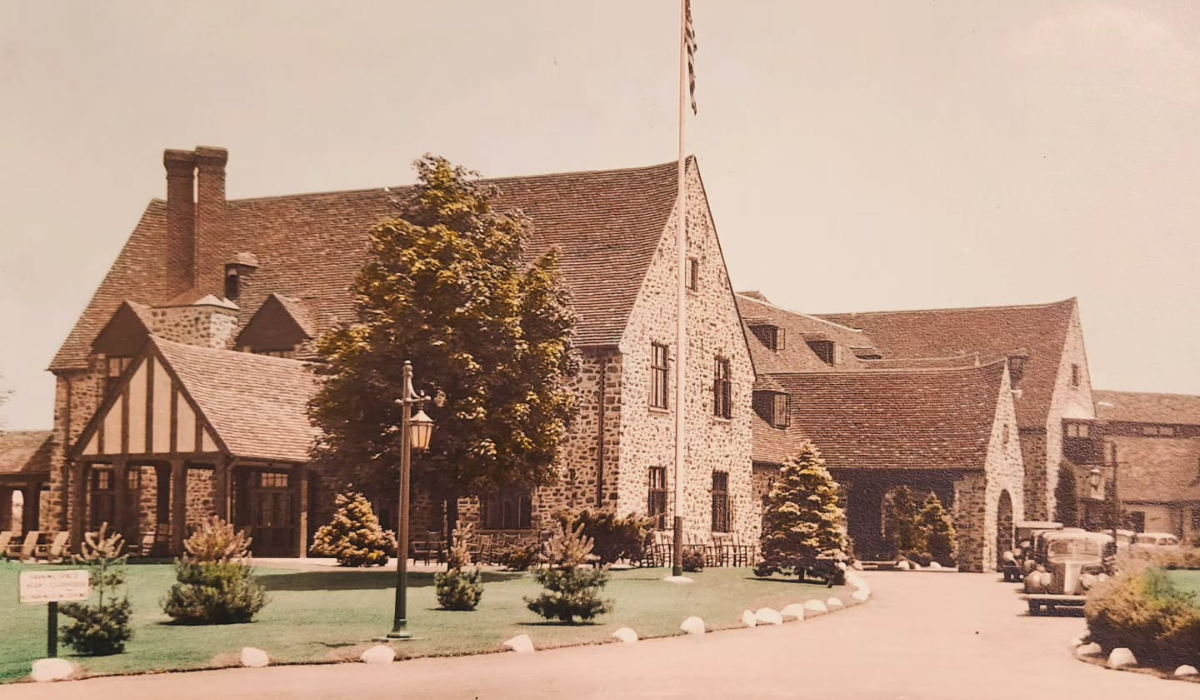
Aronimink’s history begins not in Newtown Square, Pennsylvania, but in a pale green meadow in southwest Philadelphia. In December 1896, a group of cricketers from the Belmont Cricket Club — led by Harrison Townsend — laid out a handful of rudimentary golf holes at the corner of 52nd Street and Chester Avenue. The club that grew from those humble origins eventually incorporated as Aronimink Country Club in 1900, taking its name from the chief of the local Lenape tribe, with the word variously translated as “by the beaver dam,” “where the fish cease,” or “place of the water.”
What followed was a club in motion. Aronimink moved a half-mile northwest in 1907, then six miles west to Drexel Hill in 1913, changed its name to Aronimink Golf Club in 1920, and by 1926 had settled on a 300-acre plot in Newtown Square — about 13 miles from downtown Philadelphia — where it has remained ever since. The clubhouse, designed by Charles Barton Keen, opened on Memorial Day 1928. Donald Ross was commissioned to lay out the 18 holes on the new property, and the course opened the following year, in 1929.
Philadelphia, it should be noted, is no ordinary landscape for golf. Metro Philadelphia rivals Long Island, Eastern Scotland, and Greater London in the sheer concentration of exceptional courses. Aronimink shares top-100 billing with the likes of Pine Valley Golf Club and Merion Golf Club, and it is no accident that so many legendary architects — William Flynn, George Crump, A.W. Tillinghast, Hugh Wilson — were born or bred in the region.
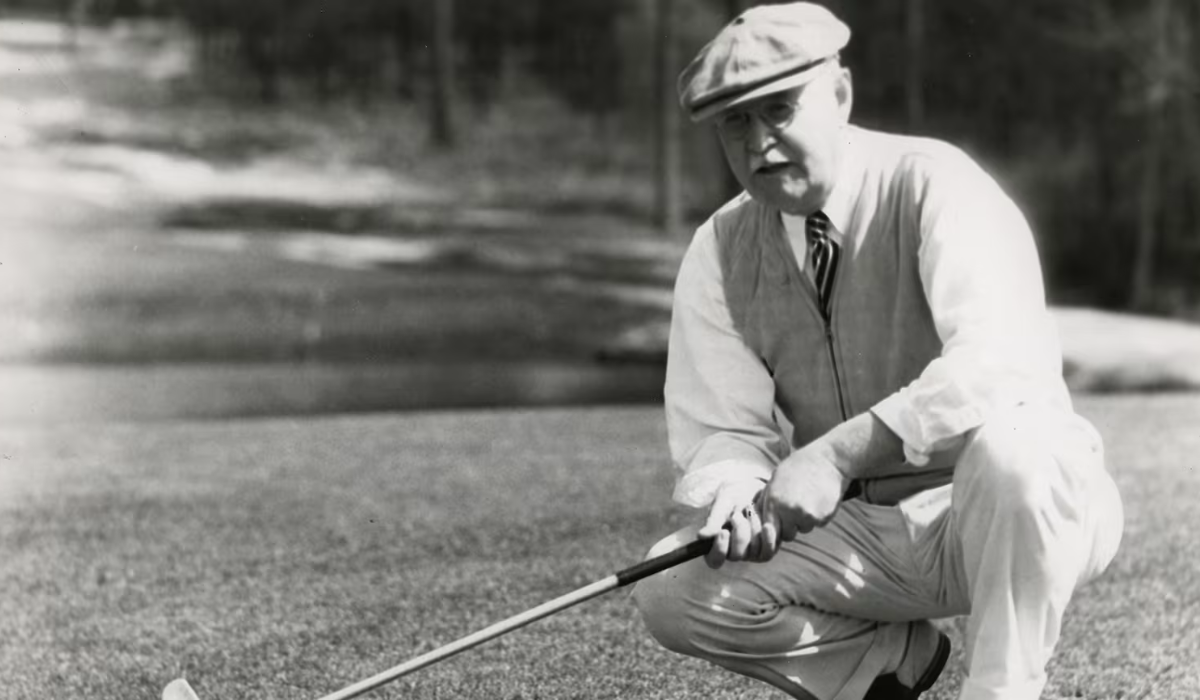
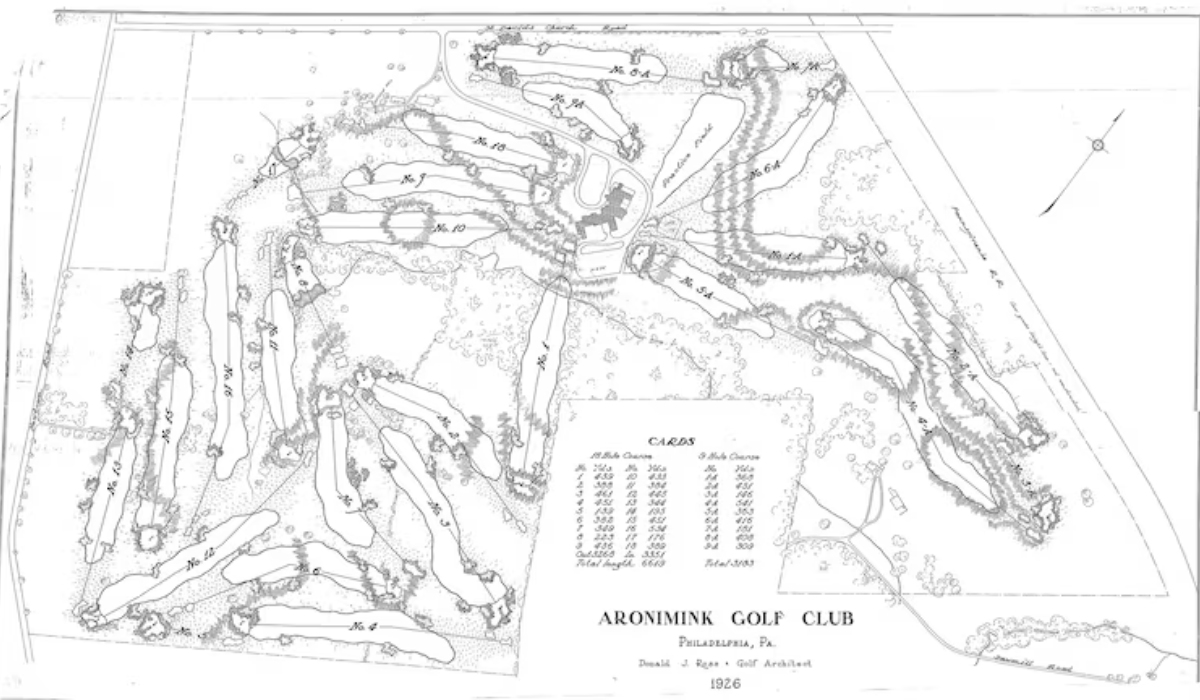
Donald Ross designed close to 400 golf courses over his career, yet he singled out Aronimink as the one in which he had surpassed himself. His routing worked with the site’s long, natural slopes to build strategy into the bones of the land, and he planned fewer than 80 hand-built bunkers cut directly into the terrain. Each hole instruction was left in the field notes for construction crews to follow while Ross managed projects elsewhere.
What happened during construction is one of golf architecture’s most intriguing stories. Ross’s regular-sized bunkers were rebuilt by his associate and foreman, J.B. McGovern — who was also a club member — as clusters of two or three smaller bunkers with lower faces, raising the total number to well over 200. This was done, it is believed, without Ross’s direct input. The result was a course that looked busier and more scatter-shot than Ross had envisioned, unlike anything else in his portfolio.
Then, over the following decades, subsequent renovators went the other direction. William Gordon arrived in the 1950s to eliminate out-of-play fairway bunkers and relocate others closer to the greens. Dick Wilson, George Fazio, and Robert Trent Jones each added their fingerprints in subsequent remodels. By the time of the course’s centennial in the 1990s, the bunkering had been reorganised into larger, more regular shapes that bore little resemblance either to Ross’s blueprints or to what McGovern had actually built.
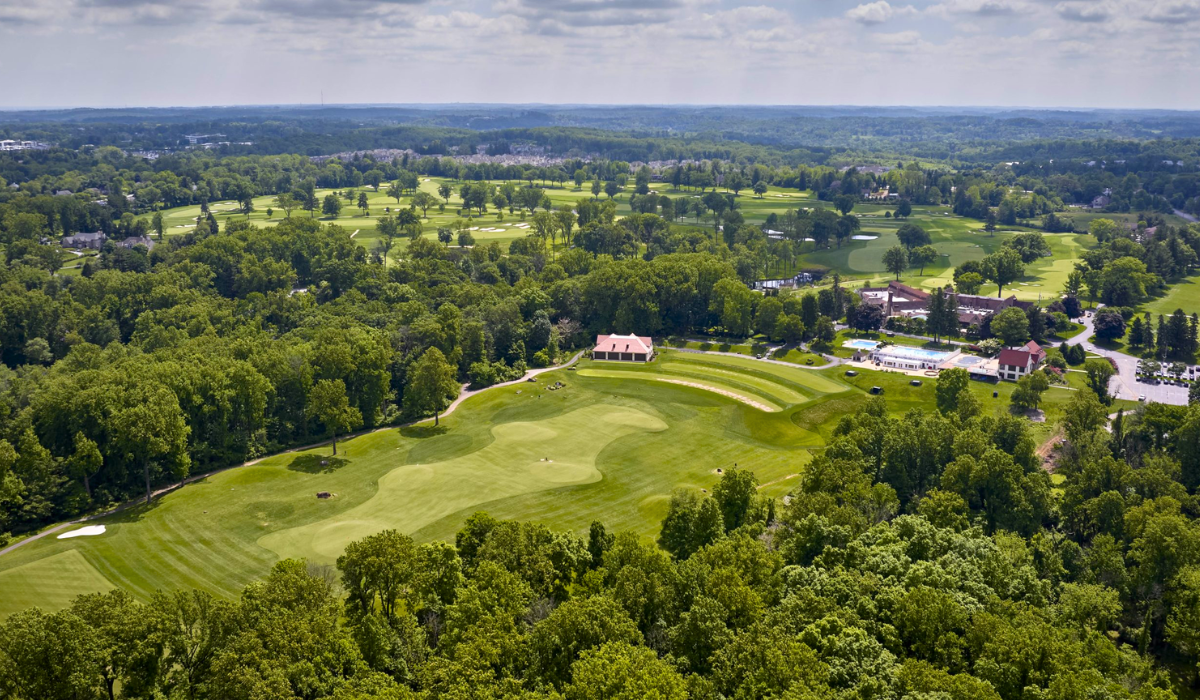
When Aronimink officials began conversations with the PGA of America about bringing the PGA Championship back to the Philadelphia area — timed to coincide with America’s 250th anniversary in 2026 — they understood the course first needed to return to its roots.
The restoration process began in earnest in 2003, when consultant Ron Prichard, a Philadelphia-area architect and considered the foremost authority on Ross’s design philosophy, completed a first phase of restoration. Working from Ross’s original blueprints, greens were restored to their original shapes and sizes, and his bunkering philosophy was reestablished. Additional length was added to each hole to bring Ross’s hazards back into play.
But then something unexpected was discovered. Archival 8mm films and aerial photographs revealed that the course Ross actually built was not the same course he had drawn. McGovern’s unsanctioned alterations during construction had diverged significantly from the blueprints. Aronimink needed a second opinion — and a second restoration.

In 2016, the club turned to Gil Hanse and Jim Wagner, both of whom live in nearby Malvern, Pennsylvania. The task was both exciting and daunting. “Whenever you’re entrusted with a great old golf course like Aronimink, and then to have it be in your own hometown, it’s pretty exciting,” Hanse said. “We were excited, but we also knew what a great responsibility it was.”
The transformation Hanse oversaw was dramatic. The bunker count jumped from 74 to 176, as he replaced the large modernised greenside bunkers with smaller, more intricate clusters inspired by the early aerial photographic record of the course — the way Ross had originally intended. Several greens were expanded by as much as 30 feet to provide additional hole locations. Fairways were widened, select trees removed to restore the parkland openness of the original design, and strategic length was added throughout.
Since the 2018 BMW Championship — the last significant professional event played here before this week — further refinements have been made. Fairways have been pinched in at landing zones to around 32 yards wide, and the rough has been grown to approximately 3.5 to 4 inches. New tee boxes have added more than 100 yards to the overall course, with the layout now measuring over 7,300 yards at par 70.
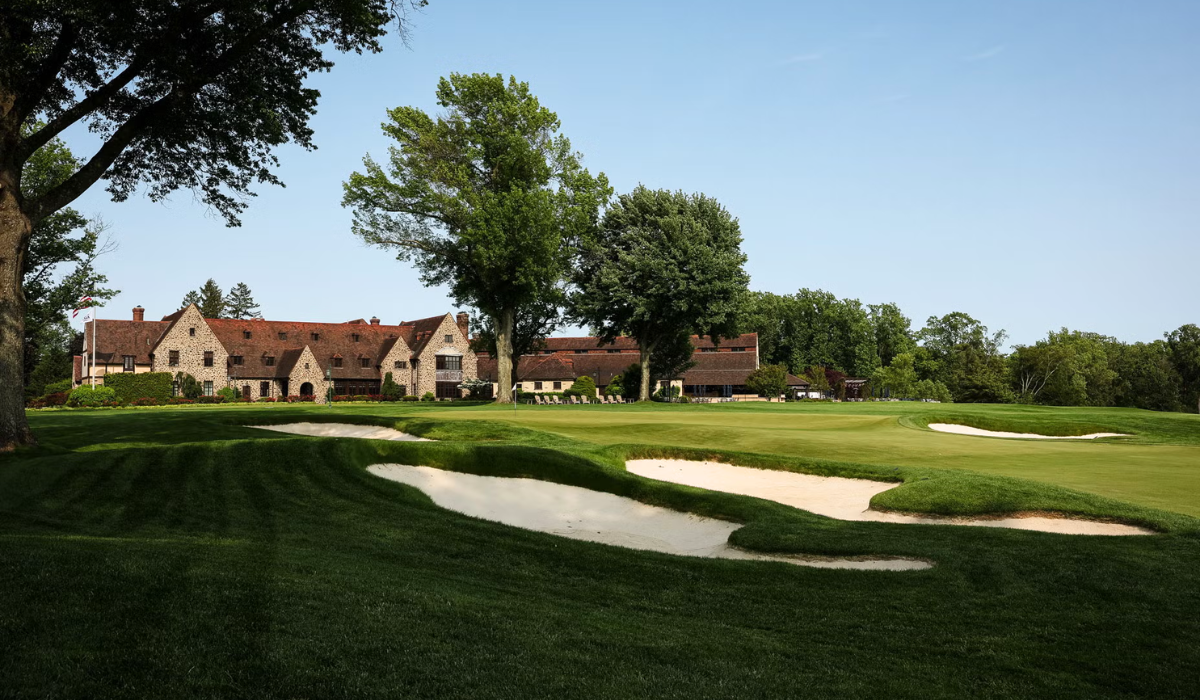
The result of all this work is a course that plays with a clarity and severity that Ross clearly intended but that the world has never quite seen before. Several features stand out.
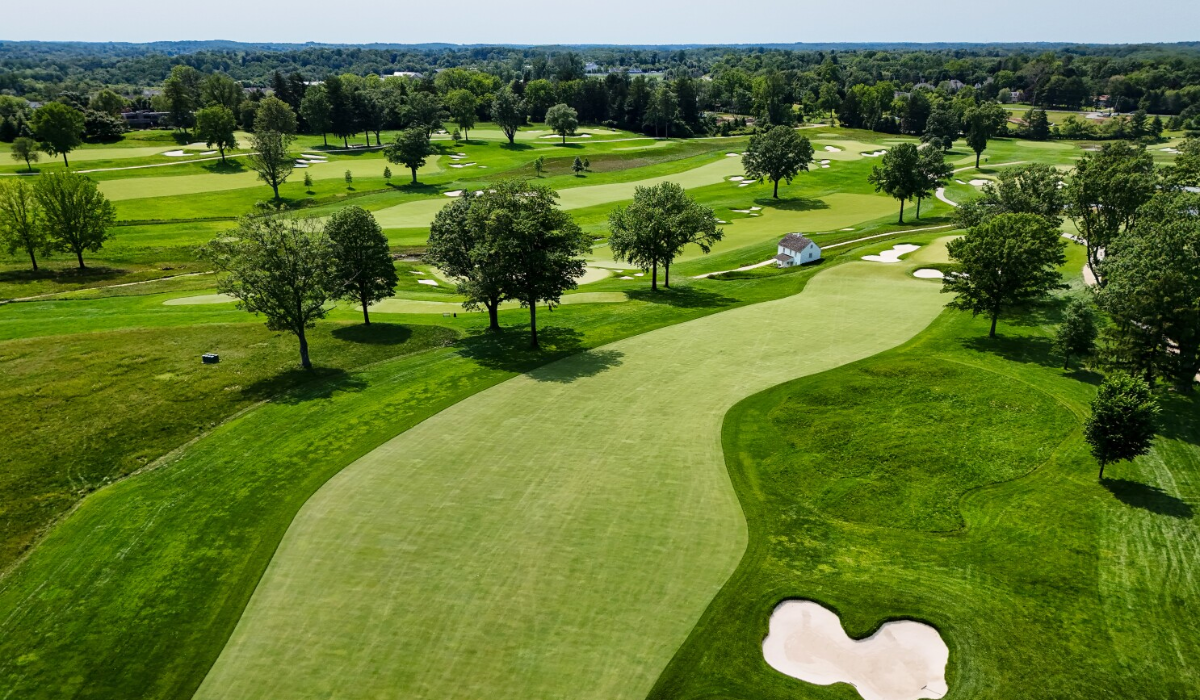
The Greens. Aronimink’s bentgrass putting surfaces — built almost a century ago, in 1928 — are widely regarded as among the most demanding in championship golf. Ross designed many of them with a strong back-to-front tilt, pronounced shoulders, and canted edges that feed errant approaches away from the hole and toward collection areas. Leaving the ball above the hole is particularly punishing. The club’s head professional, Jeff Kiddie, who has worked at Aronimink for 17 years, believes the greens will decide the championship. “As with any Donald Ross course, being able to read those greens will be key because they have such significant contours, but also an amazing series of subtle breaks within them that will be crucial,” he says.
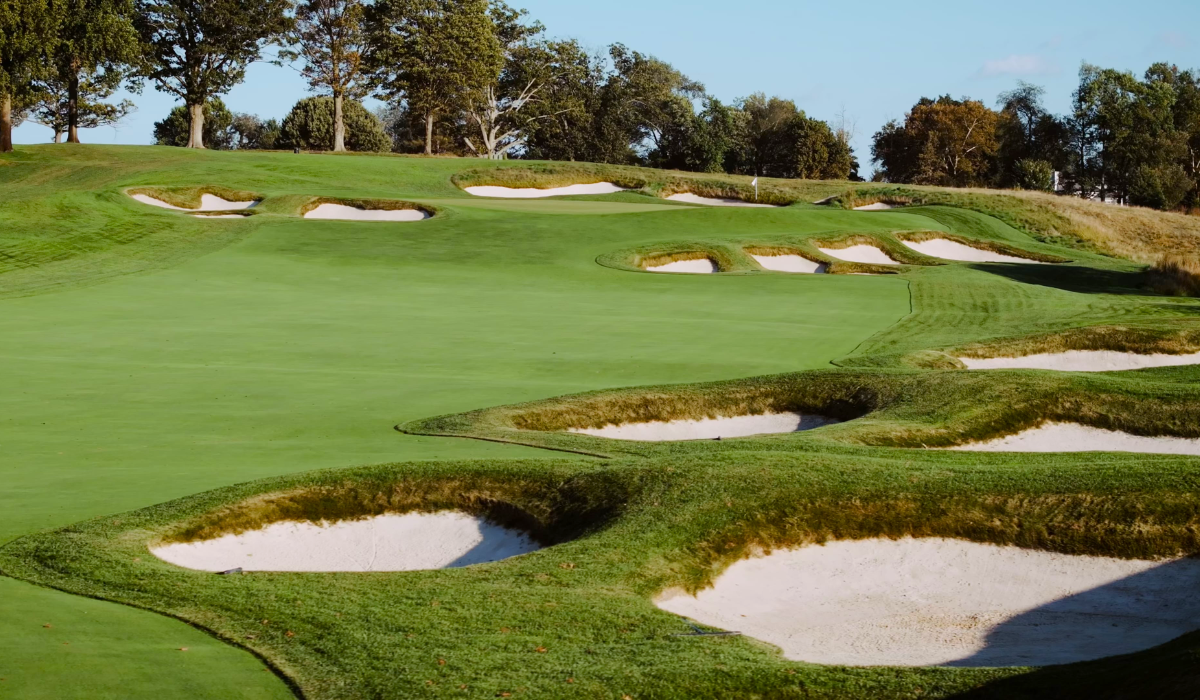
The Bunkering. With 176 bunkers now restored to something resembling the as-built condition of the course, sand is never far away. The bunkers appear in staggered clusters that challenge players to choose precise carry distances and preferred angles into greens. There is no intermediate rough alongside the fairways — the transition from tight cut to thick fescue-bluegrass rough is immediate and unforgiving. Miss a fairway, and you have a serious problem.
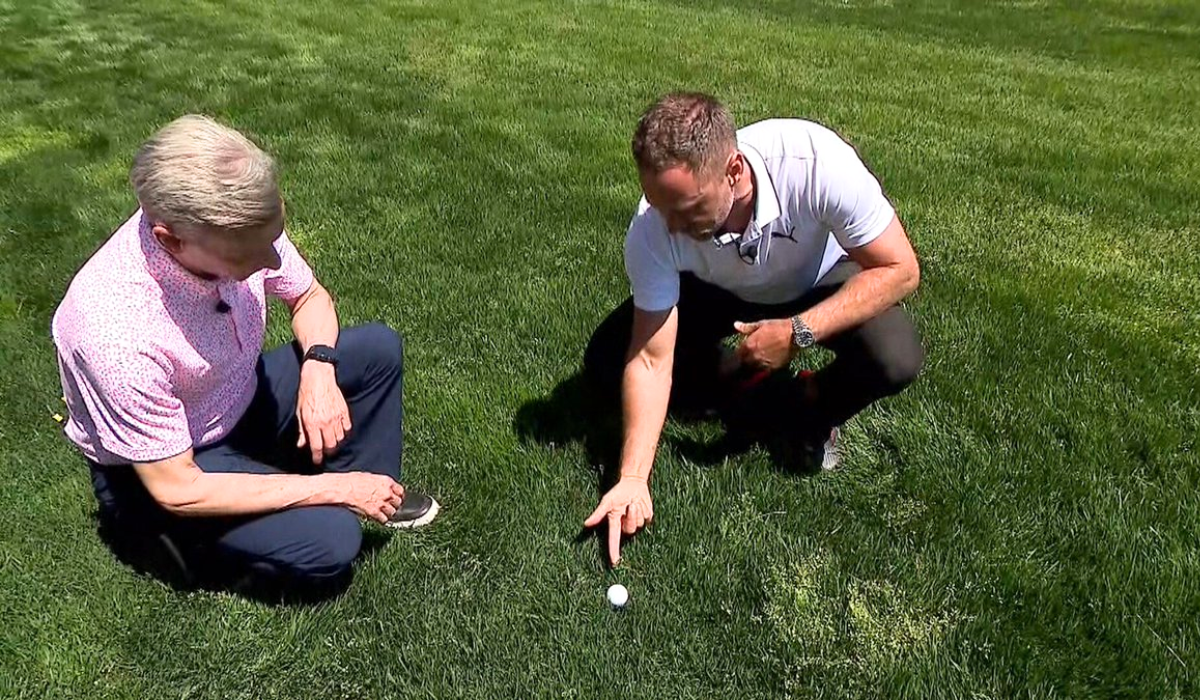
The Rough. At 3.5 to 4 inches, the rough at Aronimink is not merely punitive — it is strategic. Fairways are cut at just 3/8 of an inch, making the contrast extreme. Golf balls that run to the low side of fairways find grass that is especially thick and heavy, accumulated by irrigation runoff and fertiliser on that side of the slope. This means that precise positioning — not just clearing the rough — is essential.
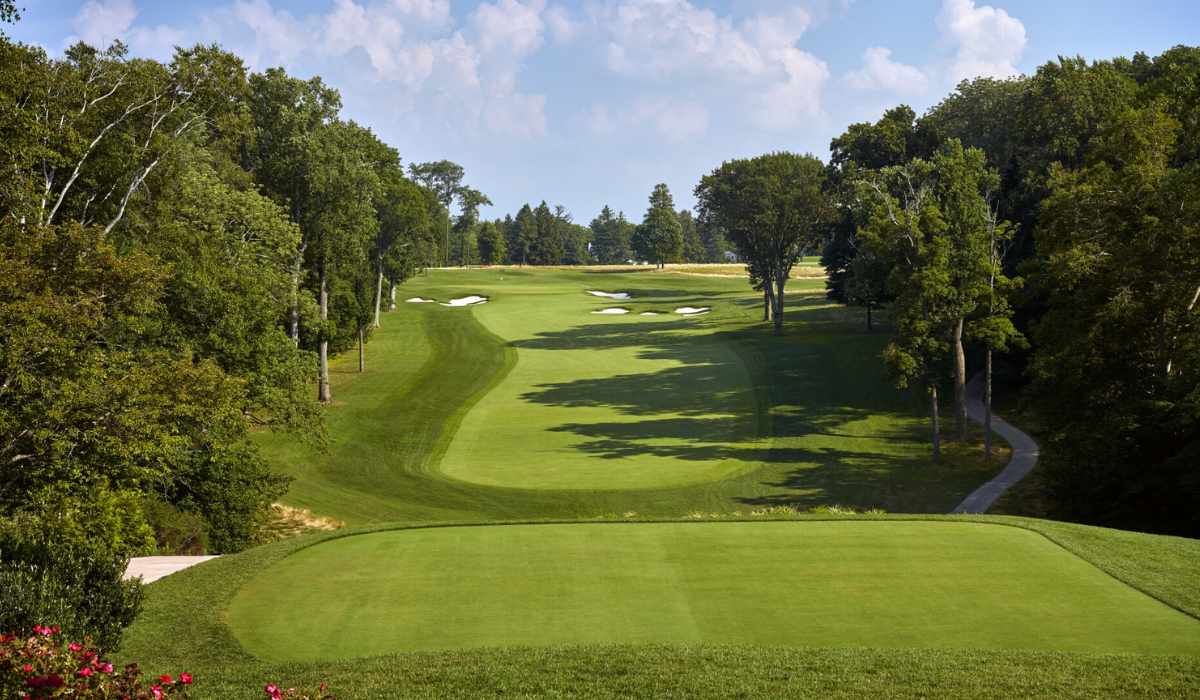
The Elevation. Aronimink’s topography is subtle but relentless. The course climbs steadily in places and drops sharply in others, with tee shots that play downhill into compressed landing zones, and approach shots that play dramatically uphill to elevated greens. The 18th hole — the longest on the course — climbs steadily uphill to the highest point on the property and the clubhouse beyond. It is a brutal finish.
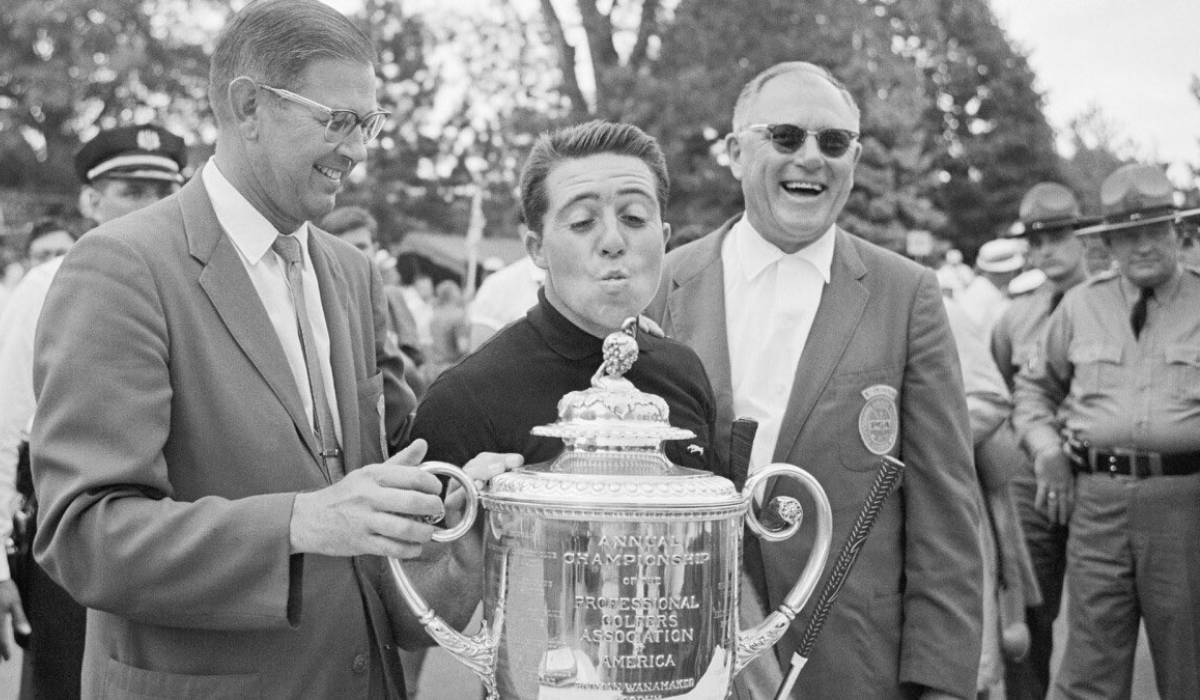
Aronimink has a championship history as complicated as its architectural one. Gary Player won the 1962 PGA Championship here by a single shot over Bob Goalby, finishing 2-under on the par-70 layout — a score that illustrates how difficult the course can be when properly set up. It remains Player’s first of two PGA Championship victories and makes him the only South African ever to claim the title.
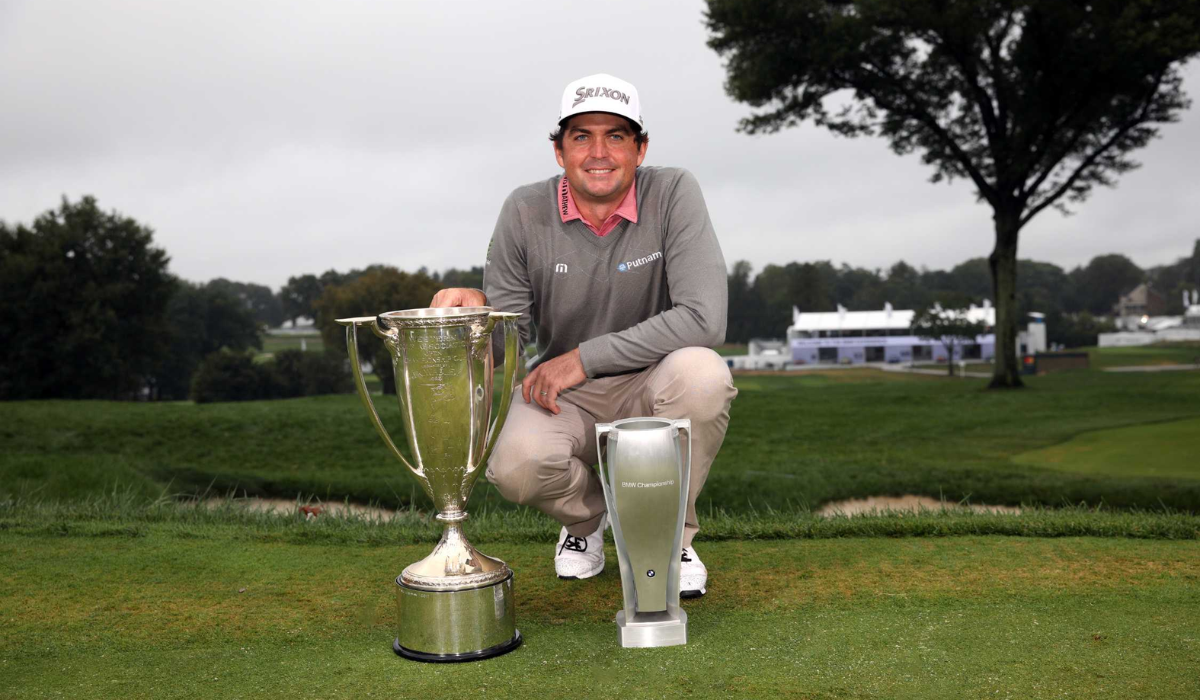
John Fought won the 1977 U.S. Amateur here 9 & 8 in the final, going on to a PGA Tour career that included Rookie of the Year honours. Justin Rose won the 2010 AT&T National, Nick Watney the 2011 edition, and Keegan Bradley shot a closing 64 to finish at 20-under and win the 2018 BMW Championship — the most recent professional event played at Aronimink, and one that course officials freely admit took place on a rain-softened, less-than-representative version of the course.

In 2020, Sei Young Kim won the KPMG Women’s PGA Championship here, making Aronimink the first venue to stage all three of the PGA of America’s rotating major championships. The 2026 PGA Championship is the first men’s major at the club since 1962 — a gap of 64 years partially explained by a dark chapter in the club’s history: Aronimink withdrew its bid to host the 1993 PGA Championship under pressure after it emerged that the club had no Black members. Reform came gradually; the club began welcoming African American members in 1998 and was fully integrated by the time the AT&T National returned in 2010.
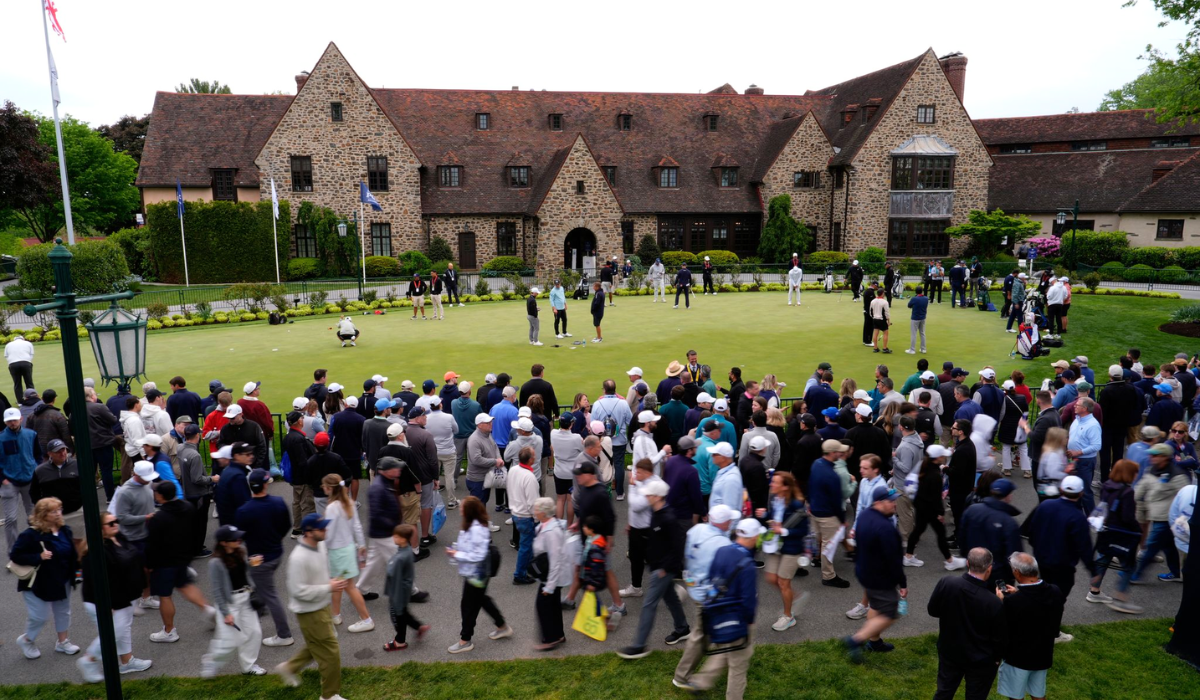
The timing of the 2026 PGA Championship at Aronimink carries a significance that goes beyond golf. The event coincides with the United States semiquincentennial — the 250th anniversary of America’s founding in 1776 in Philadelphia, just miles from Newtown Square. The city that birthed a nation is hosting golf’s only all-professional major championship on its birthday.
The field of 156 players competing for the Wanamaker Trophy this week is headlined by world number one Scottie Scheffler, defending his 2025 PGA Championship title won at Quail Hollow. Tickets for the championship rounds sold out, with grounds access for Thursday through Sunday available only through the official resale platform.
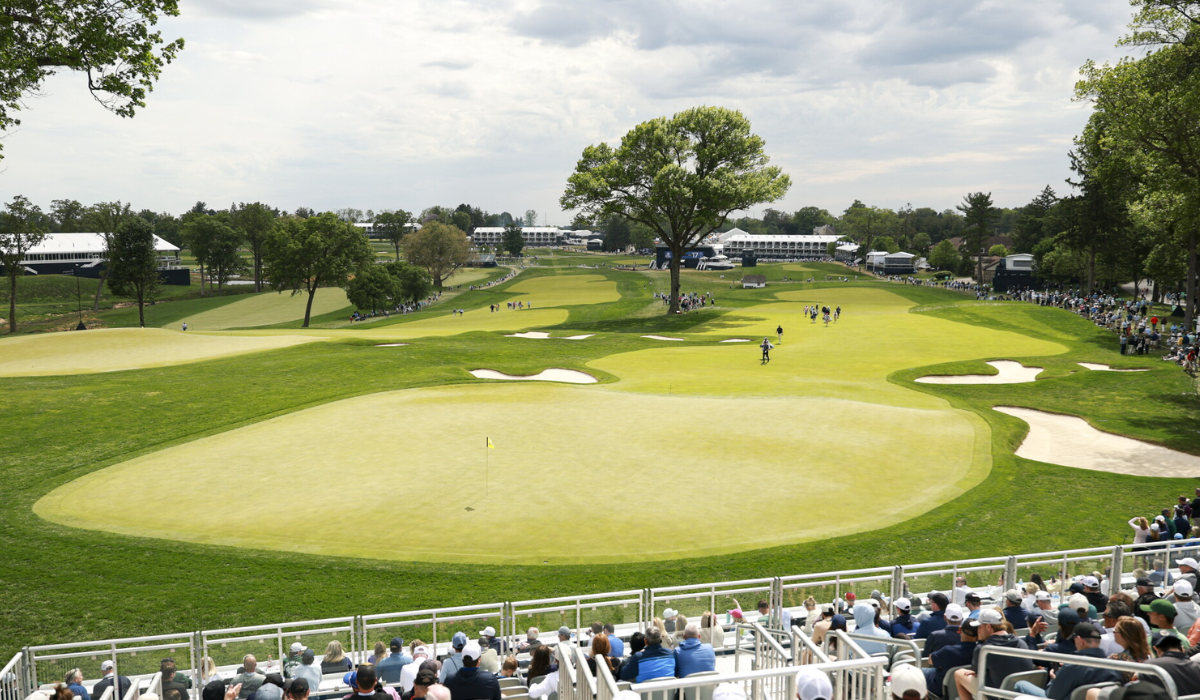
For a club that has spent nearly a century searching for its truest self — moving across the Philadelphia suburbs, surviving the meddling of well-meaning renovators, and ultimately finding its way back to Donald Ross’s original vision through meticulous archival research — the 2026 PGA Championship feels less like a return than a revelation.
Ross knew he had built better than he knew. The rest of the world is only just finding out.
Kristoffer Reitan’s Winning WITB at the 2026 Truist Championship

Destinations
Stay & Play in Las Vegas
Las Vegas has a host of resorts to choose from which offer stay & play packages and access to excellent golf courses designed by some of the greats of the industry. The ‘Entertainment Capital of the World’ is a bucket-list location for golfers with incredible places to stay and manicured courses surrounded by the Nevada […]
Course Reviews
Beyond the Autobahn: Germany’s Best Golf Experiences
Golf in Germany rarely gets the attention it deserves. Talk of European golf trips tends to gravitate toward Scotland’s links, Spain’s Costas, or Portugal’s Algarve, while Germany quietly sits on one of the continent’s most varied golf landscapes: heathland courses shaped by the same designers who built England’s finest clubs, a genuine North Sea links […]