


Course Reviews
Marrakech vs Agadir for Golf: Which Moroccan Destination Should You Choose?
Explore 33,000+ golf courses in 180 countries.
Follow the latest news and trends in golf.
Connect with like-minded golfers.
Find everything you need for your golf equipment and gear needs.
Travel, golf resorts, lifestyle, gear, tour highlights and technology.
All Square
Suggestions
Course Reviews
Marrakech vs Agadir for Golf: Which Moroccan Destination Should You Choose?
Accessories
Best Push Carts and Electric Trolleys for Golf in 2026
Course Reviews
Rediscover Monte Rei: Portugal’s Iconic Golf Course Reopens After Major Renovation
Course Reviews
Best Golf Courses Around Rome: Where Ancient History Meets Modern Golf
Instruction
Links vs Parkland vs Heathland: What’s the Difference?
Clubs
The Best Irons on the Market in 2026
Clubs
Austin Smotherman WITB: The Clubs Behind His 2026 Bank of Utah Championship Win
Destinations
Barrière Golf Properties: French Golf Escapes Where the Resort Is Part of the Experience
Destinations
Conrad Algarve Renovations: A New Chapter of Luxury in Quinta do Lago
Gear
Garmin Golf Watches Guide: Which Garmin Watch Is Right for Your Game?
PGA Tour
Presidents Cup 2026 Results & Winners: Team USA Completes Historic Comeback
Course Reviews
Cullinan Golf Links Resort, Belek: Where Golf Meets the Mediterranean
Course Reviews
New Opening: Limassol Greens — Cyprus’ New Golf Destination
PGA Tour
Presidents Cup 2026 Preview: Everything to Know Before Medinah
Clubs
Jacob Bridgeman WITB: The Clubs Behind His 2026 Biltmore Championship Victory
Course Reviews
Play Golf at Pebble Beach: What to Know Before You Go
Professional Golf
Solheim Cup Results & Winners 2026: Europe Reclaims the Trophy
Clubs
This Year’s Best Drivers on the Market: A 2026 Buyer’s Guide
Clubs
WITB: Ryan Fox’s Winning Clubs at the 2026 Open Championship
Community
How Modern Golf Courses Conserve Water and Protect Wildlife
PGA Tour
Changes on the PGA Tour from 2028
Course Reviews
Tee Off in Tuscany: Golfing Italy’s Most Picturesque Countryside
Course Reviews
The Best Golf Courses Near Pinehurst That Aren’t Pinehurst No. 2
Gear
Jackson Koivun WITB: 2026 3M Open
Clubs
Russell Henley WITB 2026: The Clubs Behind His Charles Schwab Challenge Victory
Clubs
Jacob Bridgeman Breaks Through at Riviera: WITB Behind His Genesis Invitational Victory
Clubs
Nico Echavarria’s Win: Inside the WITB at the 2026 Cognizant Classic
Clubs
Gary Woodland’s Winning WITB at the 2026 Texas Children’s Houston Open
Destinations
24 Hours at a Luxury Golf Resort: A Day in Paradise


Seychelles built its reputation on granite boulders, palm-fringed beaches, and water so clear it looks retouched. Golf was never part of that story in the way it is in Mauritius or the Algarve. And yet, tucked into the folds of two very different islands, the archipelago holds one of the more improbable rounds in world golf — a course where a par 3 drops fifty feet toward a beach postcards were invented for, and another where the ninth green sits in what used to be a mangrove swamp planted with coconut palms. Seychelles isn’t a golf destination in the conventional sense. It’s something rarer: a place where the game has had to bend itself around a landscape that refuses to be tamed.

There are only two golf courses in the entire 115-island nation, and that number hasn’t changed in over two decades. One is a relaxed nine-holer on Mahé, the country’s main island. The other is an award-winning eighteen-hole championship layout on Praslin, forty-five kilometres to the northeast. That’s it. No sprawling golf coasts, no rival resort developments racing to build the next signature hole. What Seychelles lacks in quantity, though, it makes up for with a kind of geographic drama that most manufactured golf destinations can’t replicate, because the terrain here was never flattened or reshaped to make room for fairways. The courses were built into granite outcrops, tidal mangroves, and ancient coconut plantations, and they still carry the evidence of that compromise in every hole.

On Praslin’s northwestern tip, Constance Lemuria occupies a private headland framed by pink granite boulders, tropical gardens, and three of the island’s finest beaches, among them Anse Georgette and Grand Anse Kerlan. The resort’s 105 suites and villas sit just fifteen metres from the shore, built from wood, stone, and thatch palm in a soft, sand-toned palette that leans into the setting rather than fighting it. The largest villas run to hundreds of square metres, each with a private pool, dedicated villa master, and enough space to make a family or group stay feel like its own private estate.

Days unfold across three cascading pools, seven restaurants and bars serving everything from Creole specialities to sushi and fine French cuisine, and the Constance Spa, tucked into its own garden retreat. A PADI dive centre gives access to shipwrecks and coral reefs just offshore, and between October and February, guests can join resident turtle experts to watch hawksbill turtles nest on the resort’s beaches.

Golf is where all of this converges. The Lemuria Golf Course, built into the same headland as the resort, opened in October 2000 and remains the nation’s sole eighteen-hole course. It was designed by American architect Rodney Wright alongside former European Tour player Marc Antoine Farry, and it plays to a par of 70 across roughly 5,611 metres. The routing threads through native forest, around a tidal lake system, and up granite ridgelines that force real elevation change into a course most visitors expect to be flat, tropical, and forgiving. It is neither.
The par-3 eighth is generally regarded as the toughest hole on the property: an elevated tee shot from Cap Jean-Marie that must clear mangroves and, from the back markers, carry 185 metres just to find the short grass. But the hole everyone remembers is the fifteenth. Also a par 3, it plays from a tee perched high on a rocky ridge down to a green roughly fifty metres below, with the white sand of Anse Georgette and the turquoise water beyond it filling the entire background. Despite the vertigo-inducing setting, the drop means most players are left with little more than a wedge or a nine-iron into the green — a hole that photographs like the hardest shot in golf and plays like one of the easiest.
Green fees are complimentary for resort guests, though buggies are mandatory and charged separately, and the resort’s golf pros offer private lessons for anyone looking to work on their game between rounds. Getting there requires some intent: it’s a twenty-five-minute domestic flight from Mahé, or a ferry crossing of one to two hours depending on conditions, followed by a short road transfer.

Long before Lemuria existed, golf in Seychelles meant one place: the Seychelles Golf Club at Anse aux Pins, on Mahé’s southeastern coast, about ten minutes from the international airport. Opened in 1972 on fifty acres of former coconut plantation and marshland, it’s a nine-hole course with a par around 68 and none of Lemuria’s polish — narrow, tree-lined fairways, small greens, and a distinctly unhurried, members’-club atmosphere. Roughly a hundred members keep it running, about half of them foreign residents, and it remains open to visiting golfers without the need to book, except on the club’s busier Thursday and Saturday slots.
It’s possible to play it as an eighteen-hole round by going out from a second set of tee boxes on the back nine, bringing the total to around 4,500–4,900 metres depending on which tees are used. Green fees sit in the range of 300 to 500 Seychellois rupees, making it, by some distance, the most affordable golf on the islands. What the course lacks in championship pedigree it makes up for in character: coconut palms lining tight fairways, occasional sightings of giant tortoises near the rough, and a clubhouse culture that welcomes visiting golfers into local games rather than simply selling them a tee time.

Not every golf experience in Seychelles involves eighteen holes and a scorecard. At Four Seasons Resort Seychelles, on the island’s southwest coast, guests can take part in a sunset driving session on Petite Anse beach, hitting balls out toward the Indian Ocean as the sky changes colour over roughly an hour each evening. It isn’t competitive golf, and no one is counting strokes, but it captures something true about the way the sport exists in Seychelles: as an experience shaped entirely by the geography around it, rather than the other way around.

Seychelles plays year-round, sitting just south of the equator with a warm, tropical climate that doesn’t swing between seasons the way temperate golf destinations do. The clearest distinction is between the two monsoon periods: the southeast monsoon, roughly May to September, brings steadier trade winds, lower humidity, and firmer, faster conditions — noticeably tougher at exposed holes like Lemuria’s tenth, where the wind funnels straight across the green. The northwest monsoon, from November to March, is warmer, wetter, and calmer, with short, heavy tropical showers that tend to clear quickly rather than wash out a full day.
Logistically, a Seychelles golf trip works best as an island-hopping itinerary rather than a single-base stay: a few nights on Mahé to play the Seychelles Golf Club and explore Victoria, followed by a domestic flight or ferry to Praslin to settle into Constance Lemuria, where the course is only one reason among many to stay. Golf here was never going to be about racking up rounds. It’s a reason to slow down and take in two islands — and, at Lemuria, a resort — that would be worth the trip even without a set of clubs in the hold.
Golf in Egypt: Pyramids, the Red Sea, and Some of Africa’s Most Underrated Fairways
Le Golf National Unveils Its New Identity: Inside the Albatros Course’s Long-Awaited Reopening
Destinations
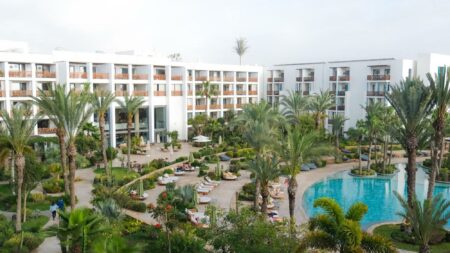
The View Agadir: Morocco’s Newest Luxury Golf Base Has Arrived
Agadir has always known how to seduce the travelling golfer. Reliably bathed in sunshine, flanked by championship courses, and edged by one of Morocco’s most magnificent stretches of Atlantic coastline, the city has long been a natural choice for those who want world-class fairways without sacrificing comfort. What it lacked, until recently, was a hotel […]
Course Reviews
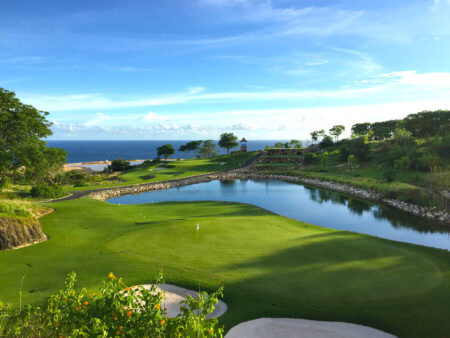
Tropical Golf in Bali
Golf on the Indonesian island of Bali includes a superb 18-hole course set in an extinct volcano and one of the best par-3 courses in Asia. One of the many provinces that forms Indonesia, the mountainous island of Bali has become a tourist hotspot, blessed with white sandy beaches, tropical jungles and historic temples. The […]