


Instruction
Links vs Parkland vs Heathland: What’s the Difference?
Explore 33,000+ golf courses in 180 countries.
Follow the latest news and trends in golf.
Connect with like-minded golfers.
Find everything you need for your golf equipment and gear needs.
Travel, golf resorts, lifestyle, gear, tour highlights and technology.
All Square
Suggestions
Instruction
Links vs Parkland vs Heathland: What’s the Difference?
Clubs
The Best Irons on the Market in 2026
Clubs
Austin Smotherman WITB: The Clubs Behind His 2026 Bank of Utah Championship Win
Destinations
Barrière Golf Properties: French Golf Escapes Where the Resort Is Part of the Experience
Destinations
Conrad Algarve Renovations: A New Chapter of Luxury in Quinta do Lago
Gear
Garmin Golf Watches Guide: Which Garmin Watch Is Right for Your Game?
PGA Tour
Presidents Cup 2026 Results & Winners: Team USA Completes Historic Comeback
Course Reviews
Cullinan Golf Links Resort, Belek: Where Golf Meets the Mediterranean
Course Reviews
New Opening: Limassol Greens — Cyprus’ New Golf Destination
PGA Tour
Presidents Cup 2026 Preview: Everything to Know Before Medinah
Clubs
Jacob Bridgeman WITB: The Clubs Behind His 2026 Biltmore Championship Victory
Course Reviews
Play Golf at Pebble Beach: What to Know Before You Go
Professional Golf
Solheim Cup Results & Winners 2026: Europe Reclaims the Trophy
Clubs
This Year’s Best Drivers on the Market: A 2026 Buyer’s Guide
Course Reviews
Fancourt: The Garden Route Estate Where South African Golf Grew Up
Course Reviews
Best Golf Courses Around Madrid
Clubs
TaylorMade Spider ZT Putter Review: What It Is, How It Performs, and Whether It’s Worth the Upgrade
Course Reviews
Your Golf Trip to Tunisia: Courses, Costs, and What to Actually Expect
Clubs
WITB: Ryan Fox’s Winning Clubs at the 2026 Open Championship
Community
How Modern Golf Courses Conserve Water and Protect Wildlife
PGA Tour
Changes on the PGA Tour from 2028
Course Reviews
Tee Off in Tuscany: Golfing Italy’s Most Picturesque Countryside
Course Reviews
The Best Golf Courses Near Pinehurst That Aren’t Pinehurst No. 2
Clubs
Cameron Young’s WITB 2026 at the Cadillac Championship
Course Reviews
Europe’s Best Golf Resorts with Exceptional Practice Facilities
Destinations
Spring City Golf & Lake Resort — Golf and Lakeside Serenity
Clubs
Nacho Elvira’s Dubai Breakthrough: WITB and a Moment to Remember
Course Reviews
Bernardus Golf: Europe’s Modern Masterpiece
Destinations
Hidden Golf Paradises in Europe You Haven’t Played Yet

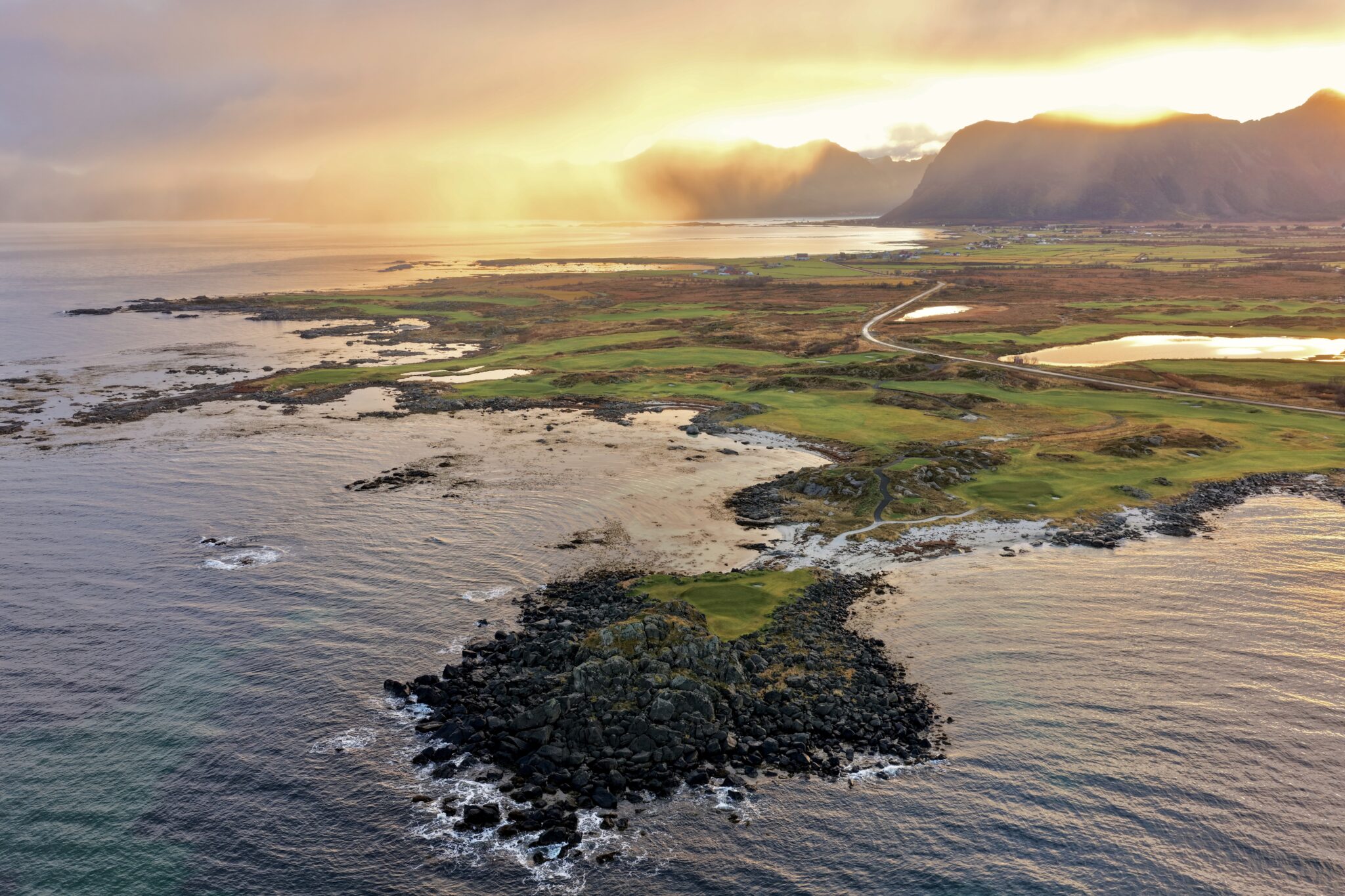
There are golf courses with great views, and then there is Lofoten Links. Perched on the island of Gimsøya in Norway’s Lofoten archipelago, well above the Arctic Circle, this is a course that does not merely offer scenery — it immerses you in a landscape so raw and so alive that the act of swinging a golf club feels almost secondary to simply being there. Mountains plunge into the Norwegian Sea. Arctic light shifts from silver to gold without ever fading to black. And on certain summer nights, you can tee off at midnight under a sun that simply refuses to set. This is not just golf. It is a pilgrimage.
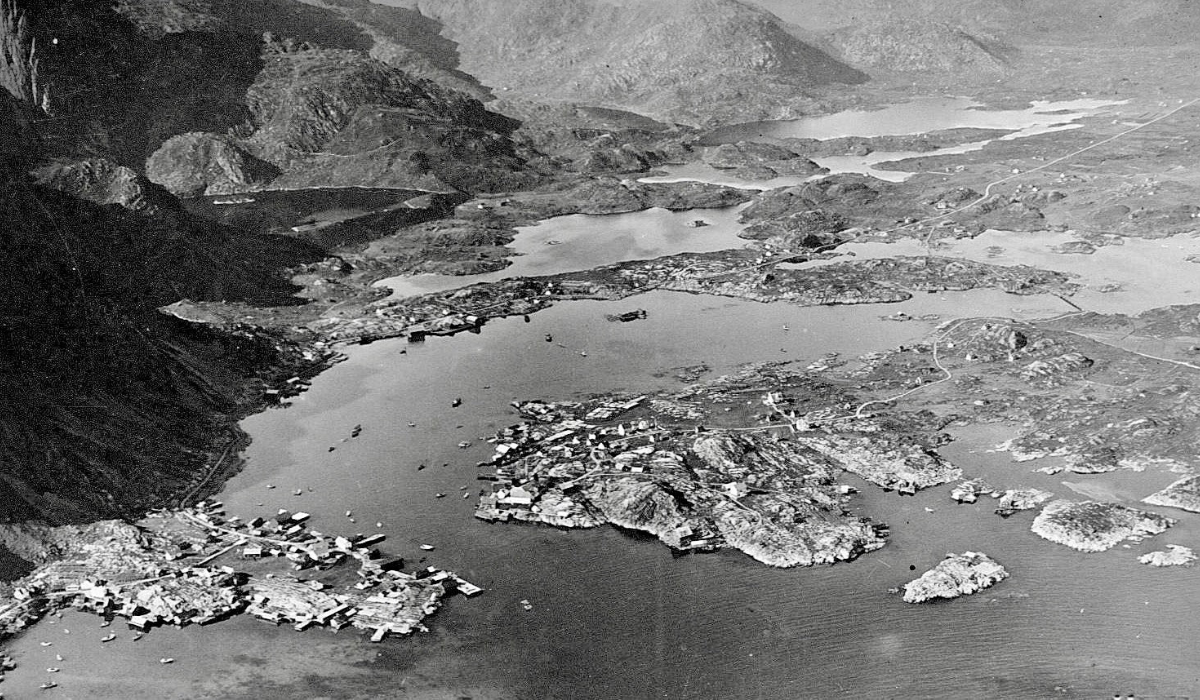
Every great golf course has a story, and Lofoten Links has one of the most human. The land on which it now sits was once the Hov family farm — a coastal estate passed down through generations on the island of Gimsøya. In the 1980s, Tor Alfred Hov, inspired by a friend’s recent trip to Scotland, began dreaming of building a world-class golf course on his family’s Arctic Ocean-front property. It was an audacious idea for this remote corner of Norway, but Tor Alfred believed the land had something special to offer the world.
He never lived to see it. When Tor Alfred passed away unexpectedly in 1993, the vision fell to his son, Frode Hov, then in his twenties, already forging a career in hospitality and tourism. Frode made a vow: he would see his father’s dream realised. He would build, as he put it, “the world’s most spectacular golf course.”
The Hov family was introduced to British architect Jeremy Turner, a landscape-trained designer who had become prolific in Scandinavian course design throughout the early 1990s. Turner took one look at the terrain — firm, links-like sand, wild coastal grasses, volcanic outcroppings tumbling into the sea — and understood immediately what it could become. Together, Turner and Frode Hov, along with Arnold Nygård, Nils Kaltenborn, and the investment vehicle Lofoten Utvikling AS, opened the first six holes in 1998. Turner himself described those early holes as representing “400 years of golfing tradition encapsulated in a few years’ work — a piece of Scotland washed up in the wilds of Lofoten.”
The course grew slowly and organically over the following two decades. Nine holes were playable by 2010. Then, between 2011 and 2014, came the defining final phase: eleven entirely new holes were constructed, four existing holes were redesigned, and the remaining three were modified. On 18 July 2015, Lofoten Links officially opened as a full 18-hole destination. A star had been born from Arctic darkness.
Tragically, Jeremy Turner passed away in early 2026, at the age of 78. In his final years, he spoke of the course with a deep, almost mystical reverence. “The course is built on an old Viking burial ground, and there’s a spiritual element to Lofoten you simply cannot escape,” he told Golfweek shortly before his death. “It is truly, truly magical.” Frode Hov, still the general manager today, called Lofoten Links “forever Jeremy’s great masterpiece.” The course stands as his most enduring legacy — a living monument to what golf architecture can achieve when it listens to the land.
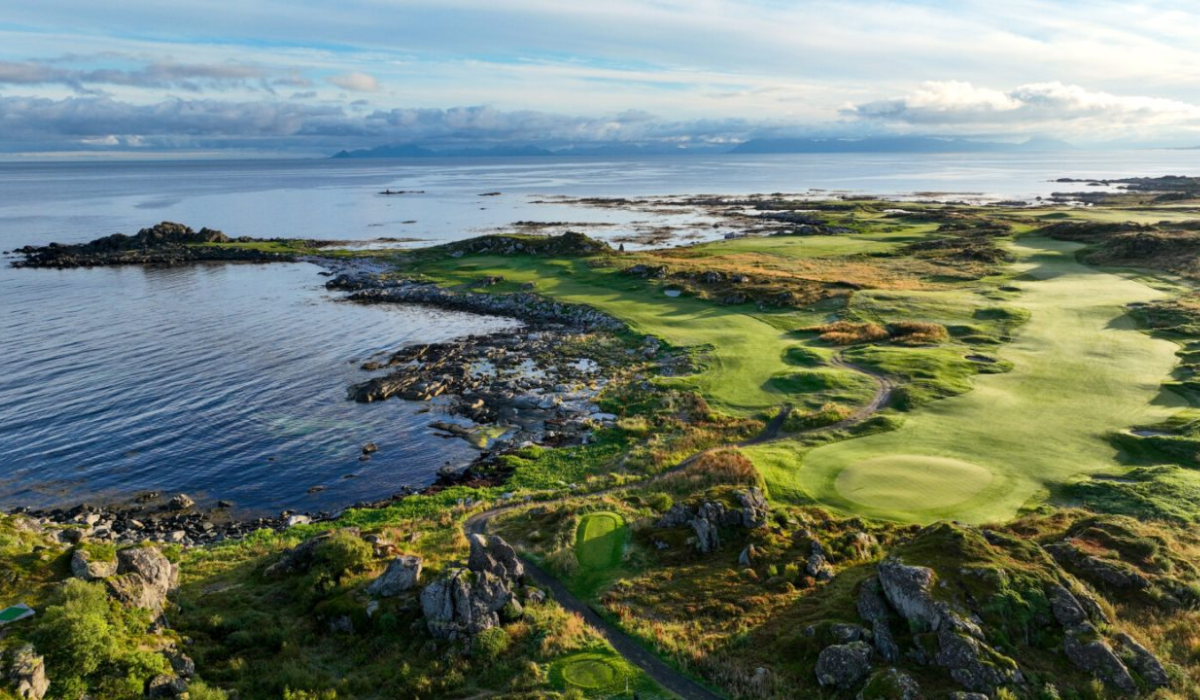
Lofoten Links plays as a par 71 over 6,662 yards from the back tees, set on terrain that is as authentically links as anything you will find in the British Isles. The underlying ground is firm and sandy, the winds are unpredictable, and the rough is made up of native coastal grasses and heather that will swallow wayward shots without apology. It is, as Turner himself observed, the antithesis of the manicured, cosmetically perfected courses that dominate modern golf — and that is precisely its power.
The course demands strategy and patience at every turn. Hit it offline, and the jagged Arctic landscape will find you quickly. Walk it (which is strongly recommended for at least one round) and you feel the terrain beneath your feet with every step — the hollow echo of links sand underfoot, the give of seaside turf, the wind off the Norwegian Sea pressing against you as you stand over a putt.
Among its 18 holes, one stands apart as perhaps the most photographed in all of Europe: the par-3 2nd. It plays 151 yards to a green positioned on a natural volcanic island stretching into the Norwegian Sea, accessible only across a narrow rocky causeway. The backdrop is the open ocean and the jagged silhouette of the Lofoten peaks. It is, by almost universal agreement, one of the most scenically breathtaking short holes in the world — and Frode Hov’s own passion project, a hole that was not part of Turner’s original design but that Frode pushed to include and which now defines the course’s identity globally.
Despite its relatively young history, Lofoten Links has climbed the world rankings with remarkable speed. The Swedish Golf Journal once described it as “a place that changes our concept of what a golf course is.” That may be the most accurate review ever written of Lofoten Links.
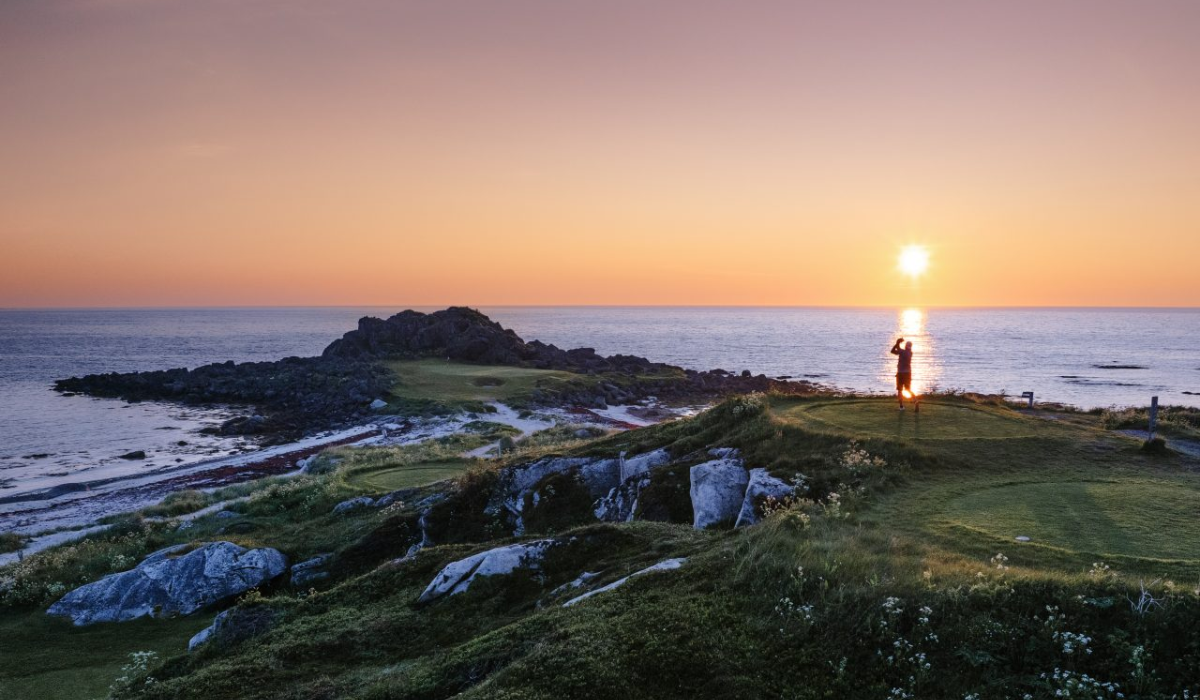
Between mid-May and late July, the sun does not set in Lofoten. For 55 consecutive days, it circles the horizon in a slow, golden arc, casting long shadows across the fairways, painting the Norwegian Sea in shades of amber and rose — then doing it again, and again, without ever going dark. The course stays open 24 hours a day during June and July. You can tee off at midnight if you want, and many golfers do.
There is something profoundly disorienting — in the best possible way — about standing on a tee box at 11 pm under full daylight, the sea glittering, the mountains glowing, the air cool and clean. Time ceases to have its usual authority. Rounds stretch on, unhurried, lit by a sky that seems to belong to another planet. It is the single most distinctive experience in all of golf travel.
The midnight sun season is, predictably, the peak period at Lofoten Links, and tee times fill quickly. Those who have experienced it consistently describe it as among the most memorable moments of their golfing lives.
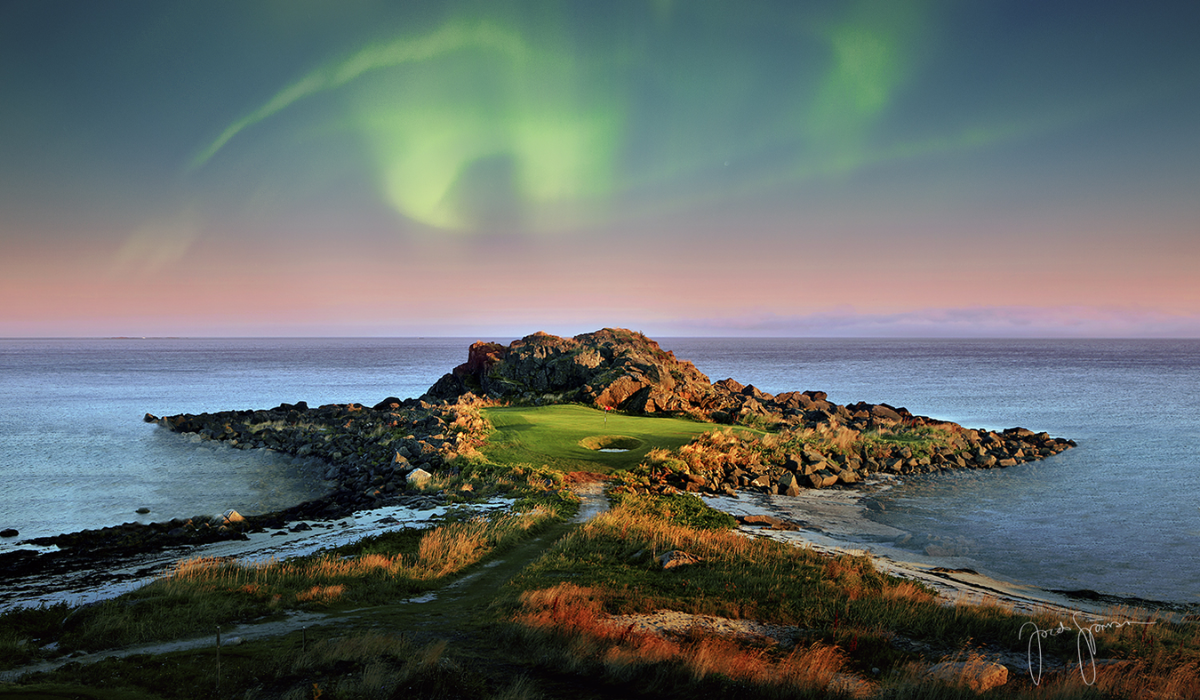
If the midnight sun represents one pole of Lofoten’s appeal, the Northern Lights represent the other. As autumn arrives and the long days begin to shorten, the Aurora Borealis starts to illuminate the skies above Gimsøya — and the lodges at Lofoten Links are designed specifically to make the most of this. Built in Nordic style and oriented to face north, towards the Norwegian Sea and away from any light pollution, they offer unobstructed views of the aurora from the moment you step onto your terrace — or, on the clearest nights, without even stepping outside at all.
The golf season runs from May through October, so shoulder season visitors in August, September, and October can potentially experience both the last embers of the midnight sun and the first appearances of the Northern Lights. Off-season stays (November through April) at the lodges focus on wellness and nature: stargazing, coastal walks, photography tours, and the atmospheric Northern Lights horseback riding tours at the nearby Hov Gård estate.
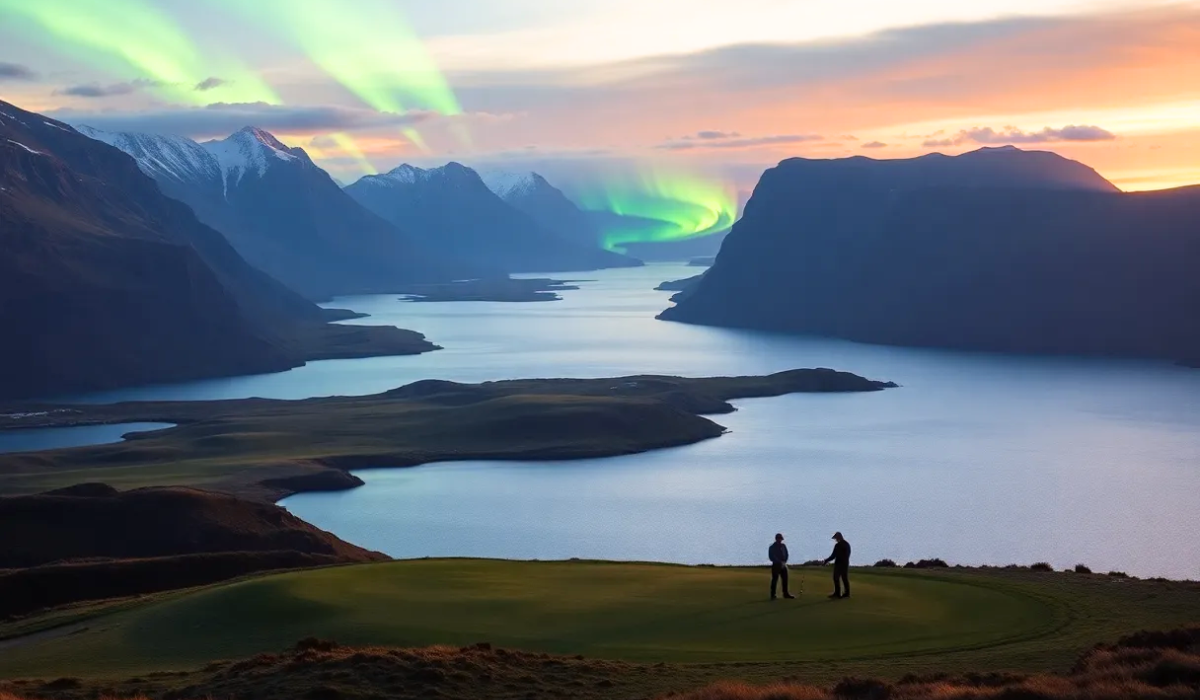
In September 2024, Lofoten Links entered a new era when The Cabot Collection — the prestigious Canadian golf resort developer — made a strategic investment in the course. Cabot’s portfolio reads like a who’s who of destination golf: Cabot Cape Breton in Nova Scotia, Cabot Saint Lucia, Cabot Revelstoke in British Columbia, Cabot Citrus Farms in Florida, and the newly acquired Cabot Highlands in Scotland and Cabot Bordeaux in France.
“We are thrilled to join forces with Lofoten Links,” said Ben Cowan-Dewar, CEO and co-founder of The Cabot Collection. “General Manager Frode Hov is a true visionary, and we couldn’t be more excited about the future of this extraordinary site.”
The investment signals a clear intention to elevate the infrastructure and guest experience at Lofoten — without, its advocates hope, smoothing away the wild, remote character that makes it irreplaceable. Frode Hov remains at the helm as General Manager, and the course’s identity as an adventure rather than a luxury resort is deeply embedded in everything it does. Cabot brings the global reach and operational excellence; Lofoten brings the soul.
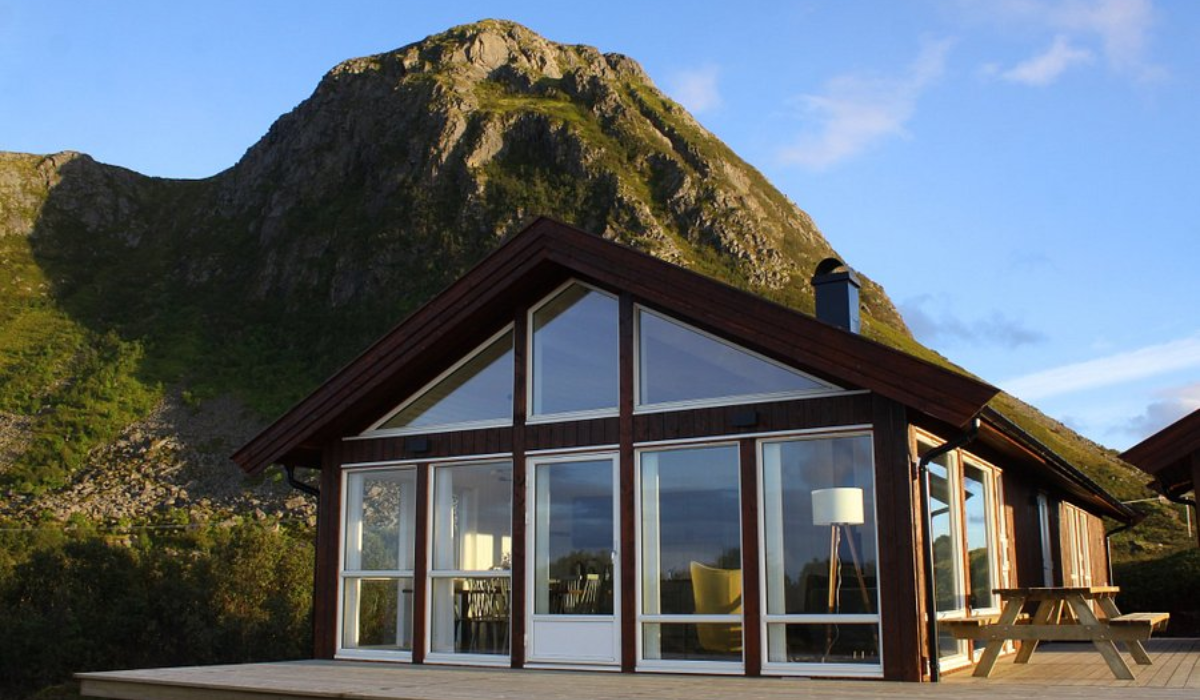
Accommodation at Lofoten Links is as thoughtfully conceived as the course itself. The lodges are clustered within a kilometre of the first tee, situated directly beside Hov Beach, and — crucially — all face north towards the Norwegian Sea. This orientation is not accidental: it ensures uninterrupted views of the midnight sun in summer and the aurora in autumn, from your terrace, your kitchen window, or your bed.
There are two main lodge categories. The Luxury Standard Lodges each contain three bedrooms, each with an ensuite shower and WC to hotel standard. They feature a fully equipped kitchen, dishwasher, washing machine, a living room with a fireplace, an outdoor patio, and an EV charging point. You can book a single room in a shared lodge, or rent the entire lodge for your group. The Deluxe Standard Lodges are larger, better suited to families and groups of up to six, with shared bathrooms, generous living spaces, and outdoor terraces — some fitted with hot tubs available at a surcharge.
For those seeking something more exclusive, there is also an off-site private retreat just 20 minutes from the course, featuring a main house sleeping up to 14 guests, a contemporary apartment for four, and a Nordic-style lodge for six. It is tailored for executive groups, destination golf events, and families seeking an elevated, more private experience.
The on-site restaurant, Låven, sits approximately 650 metres from the lodges. The name means “the barn” in Norwegian — it was, in another life, the Hov family’s agricultural building. Reviews consistently praise it as a warm and memorable place to dine after a round, with the sea as a constant backdrop. A beach sauna is also available at the nearby Hov Gård, and Icelandic horseback riding can be booked just steps from the course.
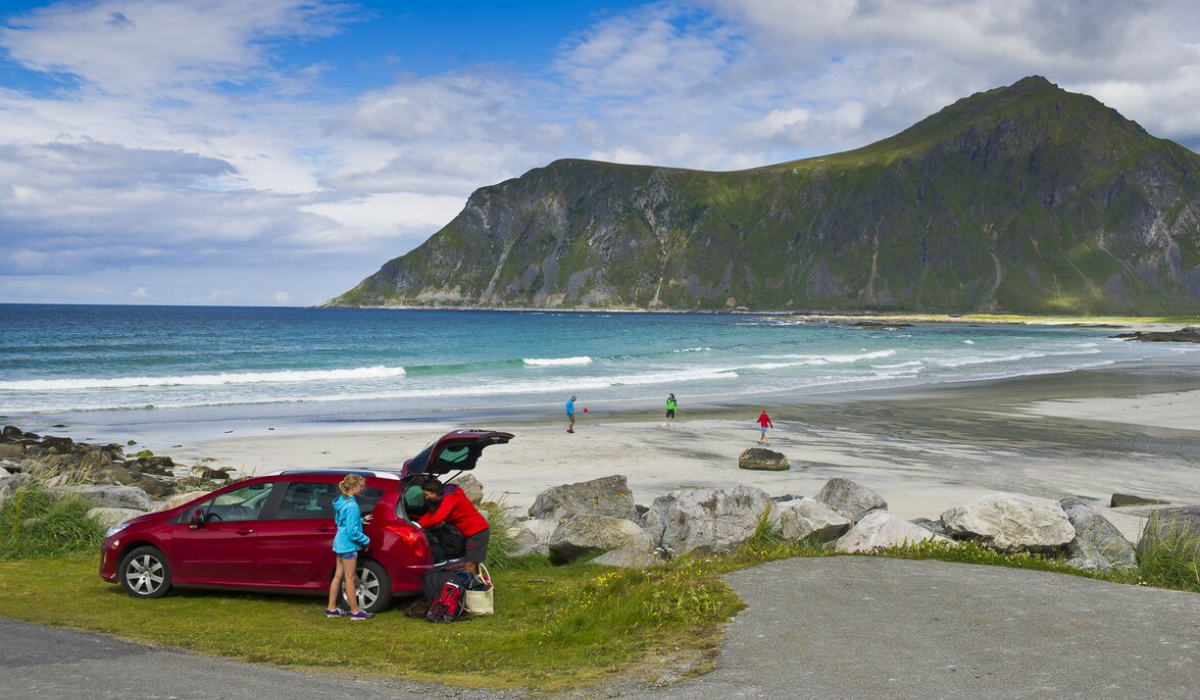
Getting to Lofoten Links is part of the adventure. The course sits in Gimsøysand on the island of Gimsøya, roughly 800 miles north of Oslo, which makes it one of the world’s most northernmost golf courses. The journey requires planning, but it rewards the effort many times over.
By air — the recommended route: Lofoten Links itself recommends flying into Harstad/Narvik Airport Evenes (EVE) as the best option, particularly for those travelling with golf clubs. This is the largest and most accessible gateway airport in the region. From EVE, it is approximately a 1.5-to 2-hour scenic drive to Lofoten Links, heading west along the E10 through the spectacular Lofoten landscape. Rental cars are available directly at the airport. From 2025, direct flights to Evenes have been expanding: Discover Airlines (Lufthansa) now operates nonstop flights from Frankfurt, and easyJet Europe offers seasonal flights from Amsterdam.
The most common international routing is: your home city → Oslo Gardermoen (OSL) → Evenes (EVE) with SAS or Norwegian Airlines → rental car to Lofoten Links. Widerøe also cooperates with SAS, KLM, Air France, and Finnair for through-ticketing from virtually anywhere in the world.
Alternatively, via Bodø: Bodø Airport (BOO) is another major gateway. From Bodø, you can either take a short regional flight with Widerøe to Svolvær Airport (SVJ, approximately 47 minutes from Lofoten Links) or Leknes Airport (LKN, approximately 50 minutes), or take the scenic three-hour Bodø–Moskenes ferry, which docks in the western Lofoten islands. The ferry is spectacular but adds significant travel time.
The scenic road option: For European travellers with time to spare, the E10 “Lofoten Road” from the mainland is one of Norway’s most celebrated drives — a sequence of bridges and tunnels threading through fjords and islands until Gimsøya appears like a vision. It connects seamlessly with the vast Norwegian road network and can be combined with a ferry crossing from Bodø if coming from the south.
Key tip from Lofoten Links: Whichever route you take, rent a car. The islands are not well-served by public transport, and driving gives you the freedom to stop, stare, and take in the landscape at your own pace, which, once you arrive, you will want to do constantly.
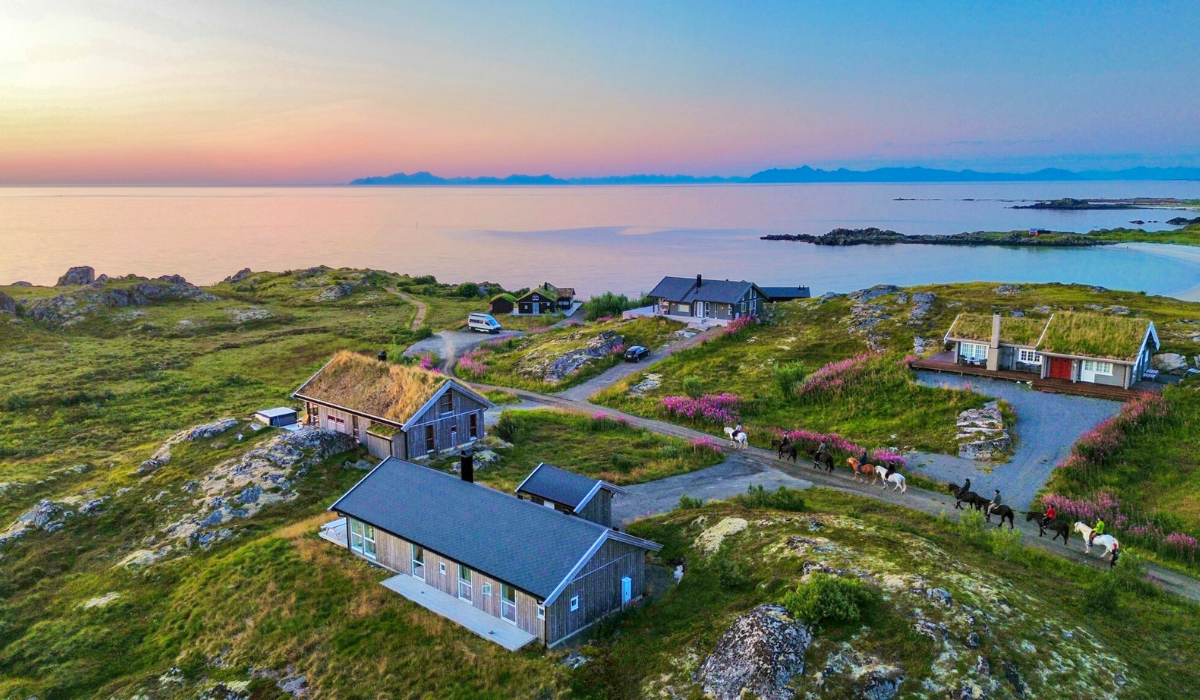
Lofoten Links is not merely a golf destination — it is a gateway to one of the most extraordinary places on Earth. The Lofoten Islands are a UNESCO-recognised landscape of staggering beauty: craggy peaks rising almost vertically from the sea, picture-postcard fishing villages clinging to rocky shores, white sandy beaches that seem borrowed from the tropics. After a round of golf, guests routinely find themselves hiking the mountain trails above Gimsøya, sea kayaking along the fjords, or visiting the Viking Museum at Borg — one of the largest excavated Viking longhouses ever found, located just a short drive from the course.
The nearby Hov Gård estate offers Icelandic horseback riding along the beach, a beach sauna facing the open sea, and during winter months, guided Northern Lights riding tours that combine two of Norway’s most elemental experiences in a single outing.
For those who simply want to sit and absorb, the terrace of any Lofoten Links lodge will do just fine. Watch the light change over the Norwegian Sea. Wait for the aurora to appear. Let the mountains fade in and out of the clouds. There is nowhere in golf quite like this — and very few places on Earth, period.

Travel
Interview with David Perez, CEO for the Tenerife Tourism Board
We spoke to David Perez, CEO for the Tenerife Tourism Board, and asked him what measures have been taken to make Tenerife Destination a safe place to visit, explore and play golf during the global Covid-19 pandemic. How did you deal with the COVID-19 situation initially? From the outset, Turismo de Tenerife sought to obtain […]
Course Reviews
Kytäjä Golf & Uni Villa: Finland’s Lakeside Golf Retreat
Nestled amid serene forests and the shimmering waters of Lake Kytäjä, about an hour north of Helsinki, Kytäjä Golf is a true embodiment of Finnish beauty and tranquillity. It’s a destination where unspoiled nature, elegant design, and world-class golf blend seamlessly. With two championship courses, stylish lakeside accommodation at Uni Villa, and the beautifully restored […]